
Start with firsts
Firsts matter because they change the story from ‘I might’ to ‘I did.’ In running, a first milestone creates a clean reference point and usually needs no external ranking to feel important.
- first continuous mile
- first 5K
- first 10K
- first half marathon
Add progression and performance
Once the basics are established, progression milestones create the next rung. These can be speed, scoring, terrain, technique, volume or skill depending on the pursuit.
The useful test is whether the recipient can explain why the milestone matters without needing a leaderboard.
- first marathon
- sub-30 5K
- sub-25 5K
- sub-20 5K
Make consistency and lifetime progress visible
Consistency milestones reward the unglamorous work that makes bigger achievements possible. Lifetime totals do something different: they show how small sessions become a body of work over years.
For running, this might mean accumulated sessions, distance, days, catches or other long-term totals.
- first race finish
- podium finish
- 1,000 km lifetime
- 5,000 km lifetime
Keep people, places and meaning on the list
A milestone system becomes richer when it includes who you were with, where it happened and why it mattered. That is where miles, pace, race days and the routines that happen between finish lines stops being a spreadsheet and becomes a story.
You do not need to track every possible event. A smaller set of milestones that the person actually cares about is more motivating and more displayable.
- A memorable trip or destination
- A shared day with friends or family
- A charity or purpose-driven event
- A comeback after time away
- A tradition repeated over time
A useful running milestone ladder has more than distance
The obvious ladder is one mile, 5K, 10K, half marathon and marathon. It works because each step changes what feels possible. But an all-distance ladder can make progress disappear during years when a runner is focused on speed, consistency, travel or simply staying healthy.
A richer milestone system adds parallel tracks: a faster 5K, a first race, a podium, a year of monthly running, a major lifetime-distance threshold, a charity run or the Six Star journey. That gives more runners legitimate reasons to recognize progress without pretending every path ends at 26.2 miles.
- Distance milestones
- Pace and performance milestones
- Consistency and lifetime totals
- Race, travel and community milestones
Build a milestone ladder, not a wall of pressure
A useful running milestone system has nearby goals and distant goals at the same time. If every target is huge, progress disappears for months. If every target is easy, none of them feel meaningful.
Mix measurable thresholds with experiences and consistency. That gives beginners a way in, experienced people somewhere to go next, and everyone a few milestones that matter for reasons a leaderboard cannot capture.
- 1Include one achievable next step.
- 2Include one stretch goal.
- 3Include one consistency goal.
- 4Include one people/place/memory goal.
COMMON MISTAKES
A DIFFERENT KIND OF KEEPSAKE
Give the achievement a place to live.
If the milestone matters enough to remember, Hexonumia gives it a physical place: a 22-position collector display, 30 hand-finished achievement pieces, an eight-token companion vault and customizable wording on both board plaques.
Launch price requires code LAUNCH50 at Stripe checkout.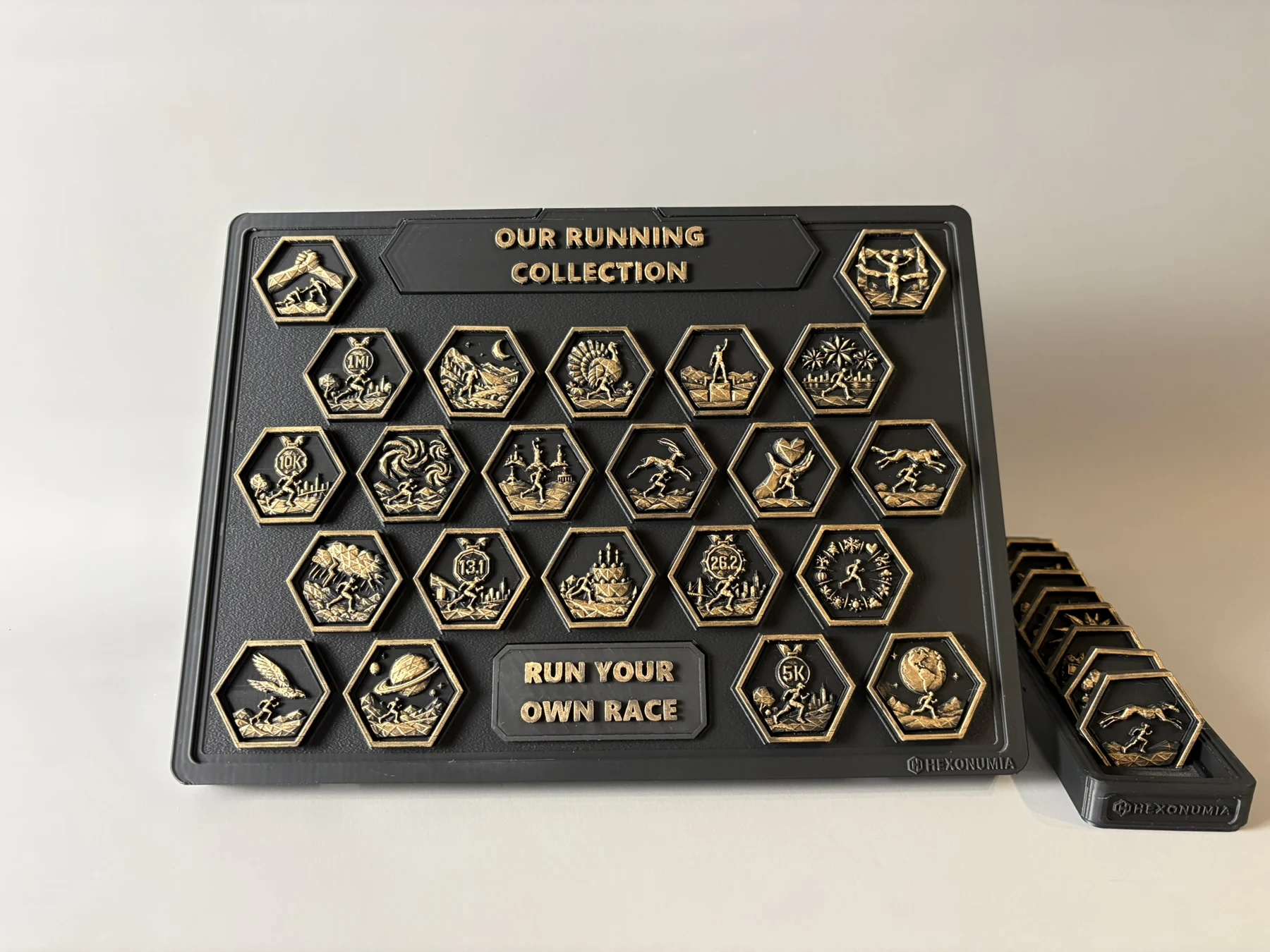
QUESTIONS PEOPLE ASK
Quick answers.
How many running milestones should I track?+
Enough to create visible steps without making every session a checklist. A mix of firsts, progression, consistency and meaningful experiences usually works better than one long numerical ladder.
Should milestones be objective or personal?+
Both. Objective thresholds are easy to recognize, while personal milestones capture the meaning that standardized lists miss.
How do I celebrate a small milestone?+
Match the celebration to the meaning. A note, photo, token, shared meal or physical marker can be enough; not every milestone needs a large purchase.
Does Hexonumia include every possible milestone?+
No. Each collection uses 30 curated achievements designed to cover different kinds of progress while leaving the owner free to decide what belongs on the display.
SOURCES & RESEARCH METHOD
Research-backed, with sources you can inspect.
We reviewed current specialist and mainstream coverage to understand the advice and gift categories people encounter when researching this topic. These sources provide market context; Hexonumia product claims come from our own physical product specifications.
Broad current gift-guide coverage shows how competitive generic runner-gift queries are and how often gear, comfort and keepsakes recur.
Visit source ↗Fleet FeetThe Best Gifts for RunnersA specialist retailer segments runner gifts by experience, personality and use case rather than treating every runner the same.
Visit source ↗ShutterflyPersonalized Marathon Finisher GiftsIllustrates strong intent around commemorating a specific race with names, dates, times and other personal details.
Visit source ↗